NetworkOperations.GuruExecutive field intelligenceWeekly field brief

TGIF · September 11, 2026

AI earns operational authority one bounded workflow at a time.

The inaugural NOG reading brief: three evidence-rich pieces that move the discussion from AI capability to operational assurance.

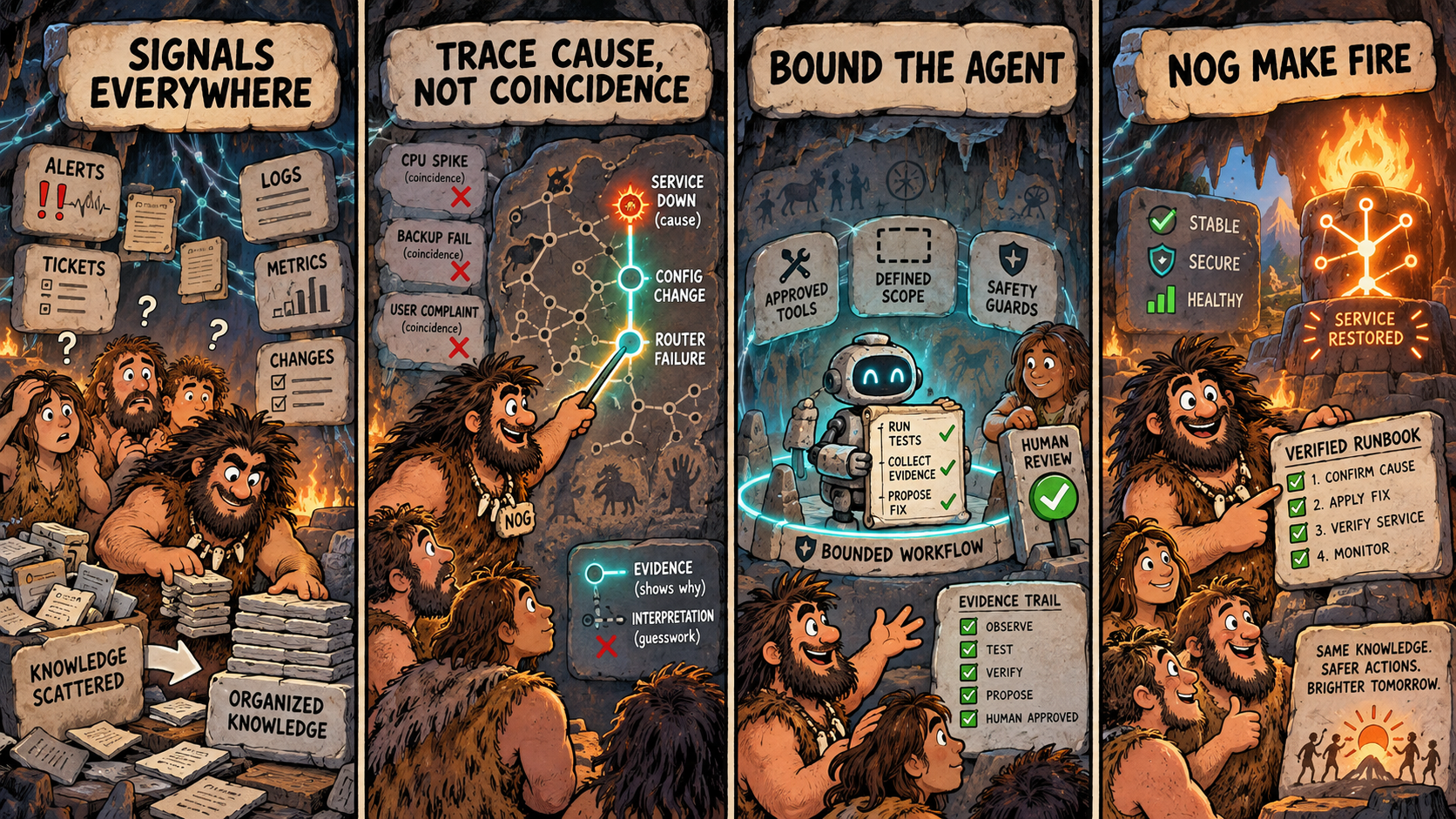
Four-panel NOG storyboard: organizing scattered operational signals, tracing causal evidence, bounding an AI agent with human review, and restoring service with a verified runbook.
Evidence is the glowing path; interpretation stays labeled; action waits behind a bounded workflow and human review.

The reading list

Three pieces worth leadership attention

01
July 24, 2026Bin Dong and the ESnet ORBIT team

Building AI That Works: ESnet’s Pragmatic Approach to AI-Driven Operational Excellence

What the evidence says

ORBIT embedded bounded AI tasks into ESnet’s ServiceNow-centered NOC workflow. All six initial tasks were delivered; six of seven operators adopted the chat interface, generating 72 conversations and more than 1,200 tool calls. Engineered skills cut one measured workflow from 10 agent actions to four and eliminated observed retries.

Useful takeaway

The strongest near-term use of agentic AI is not autonomous remediation. It is evidence-grounded assistance inside the tools operators already use: handoff summaries, timelines, procedure retrieval, priority recommendations, and draft close notes.

Where it strengthens NOG

What’s Becoming Table Stakes — “The NOC AI operating model: bounded skills, workflow integration, and measurement before autonomy.” Handbook angle: selecting low-risk workflows, defining operator checkpoints, and instrumenting cost, latency, edits, and failure modes.

Evidence limit

This was a six-month exploratory deployment with a seven-person NOC cohort. It demonstrates practical adoption and workflow gains, not a broad causal proof of MTTR reduction or safe autonomous action.

Read the source ↗
02
June 11, 2026Fabien Chraim, Jian Zhang, Dominik Janzing, Xiang Song, Christos Faloutsos, and John Evans

NetCause: Counterfactual Learning for Root Cause Analysis in Large-Scale Networks

What the evidence says

NetCause learned fault propagation from 1,500 production incidents and was evaluated on 31 expert-labeled incidents. Its top-ranked hypothesis exactly matched a valid root cause in 35.5% of cases—16.1 percentage points above a rule-based heuristic—and inference remained operationally practical.

Useful takeaway

Network diagnosis needs to move beyond “what happened nearby” toward “what would have prevented the impact.” Counterfactual ranking can narrow an operator’s first move, but the 35.5% top-hit rate is also a warning against closed-loop remediation without independent checks.

Where it strengthens NOG

What Is → What’s Becoming Table Stakes — “Correlation is not causation: rebuilding RCA around topology, time, and counterfactual evidence.” Handbook angle: confidence thresholds, candidate queues, operator verification, and escalation rules.

Evidence limit

The labeled evaluation set contains only 31 incidents from one cloud-provider environment and assumes no hidden confounders in the modeled dynamics. Generalization to enterprise networks remains unproven.

Read the source ↗
03
Revised August 29, 2026Muhammad Bilal, Jon Crowcroft, Ruizhi Wang, Xiaolong Xu, and Schahram Dustdar

Large Language Models for Agentic NetOps and AIOps: Architectures, Evaluation, and Safety

What the evidence says

This 59-page evidence-stratified survey finds a capability–assurance gap: evidence is comparatively stronger for read-oriented assistance and tool-grounded diagnosis, then thins as systems approach configuration change, bounded execution, and closed-loop control.

Useful takeaway

Evaluate the whole operational workflow, not just answer quality. Tool permissions, evidence traces, invariant checks, execution budgets, sandbox replay, canaries, rollback, auditability, and human intervention are the real control plane for agentic operations.

Where it strengthens NOG

Future State — “The autonomy contract: how NOC leaders grant authority without surrendering control.” Handbook angle: a tiered delegation model that links each autonomy level to evidence, permissions, gates, rollout, and rollback duties.

Evidence limit

This is a survey and design synthesis, not a controlled production trial. Its assurance-contract framework is compelling, but organizations still need to validate thresholds and controls against their own failure modes.

Read the source ↗

The connective tissue

The model is not the operating model.

Across practical deployment, causal RCA, and the agentic-safety survey, the same pattern holds: useful AI depends on the machinery around it. Knowledge access, scoped tools, evidence trails, testable skills, human gates, and rollback are becoming the minimum viable operating system for AI-assisted network operations.